
Who Is Making Our Music?
The compact disc once carried a three-letter account of its recording process. An AI-era equivalent could make human contributions visible, provided the industry learns from the limits of the original.
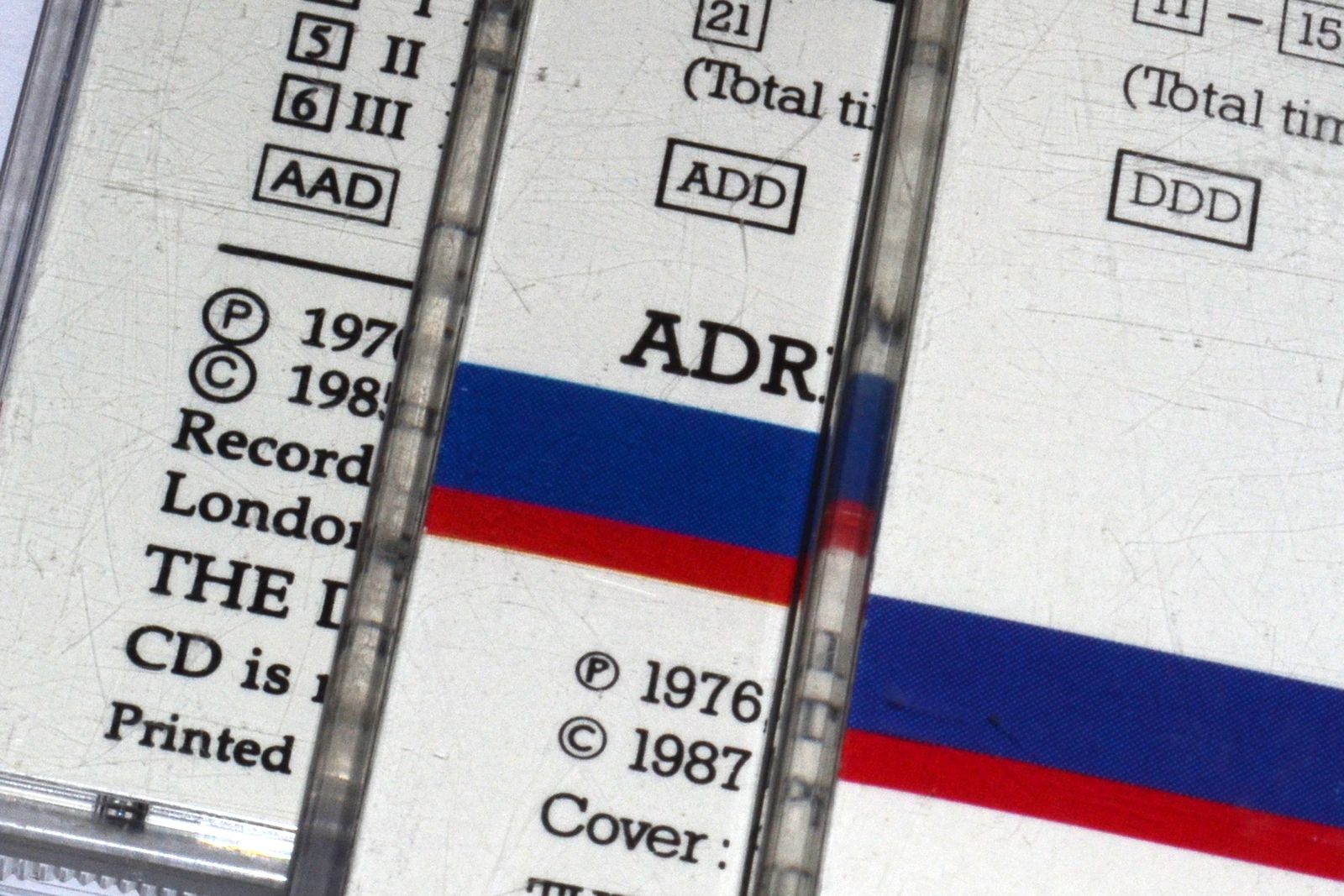
SPARS codes on 1980s Decca CD packaging.
Photo by Attosaur · Source · CC BY-SA 4.0. Original photograph retained. The website resizes the image and crops it to fit the frame.

Nearly half a century has passed since Queen released News of the World in 1977, the landmark album that gave us “We Will Rock You” and “We Are the Champions”. Its cover placed the musicians at the mercy of a giant robot. Seen today, that image raises an uncomfortable question about human and robotic servitude: who serves whom? Queen’s account of the album · View the original cover on Queen’s website
There are visual and thematic echoes here of Fritz Lang’s Metropolis, released in 1927, half a century before Queen’s album: human labour, machine power and the fear of losing control of what we have built. Lang’s film imagined workers subordinated to an industrial order; Queen’s cover offers its own disturbing reversal of human command over machines. Nearly another fifty years on, those anxieties have entered the process of making music. BFI on Metropolis
The cover itself has a clear creative lineage. Frank Kelly Freas adapted his own illustration for the October 1953 issue of Astounding Science Fiction, made for Tom Godwin’s story “The Gulf Between”, after Roger Taylor brought it to the band’s attention. The echo of Metropolis is a way of reading the image; Freas’s earlier painting is its documented source. That distinction between interpretation, influence and identifiable creative work matters when we ask who is making our music now. Queen’s account of the cover; Sotheby’s catalogue
Turn over a compact disc from the 1980s or 1990s and, somewhere among the copyright notices and production credits, you might find three letters: AAD, ADD or DDD.
Small enough to overlook, they offered a compressed history of the recording. Before you pressed play, you could learn something about the machinery through which the music had passed.
Music needs that kind of clarity again. This time, the questions reach beyond the recording equipment. Who wrote the melody? Who supplied the words? Is that a singer’s recorded performance, a generated voice, or a combination? Did AI suggest a direction, restore an existing recording, or generate material that made it into the release?
Those are different contributions. A single “AI music” label leaves most of them unexplained.
What those three letters actually meant
The SPARS code came from the professional recording organisation of the same name. It described three stages: the original recording, editing and mixing, and mastering. Each position identified an analogue or digital recording format.
AAD generally meant analogue recording and mixdown, followed by digital mastering. ADD meant an analogue recording subsequently mixed or edited to digital, then digitally mastered. DDD indicated digital recording at all three stages. The final D was unsurprising on a compact disc. Yale Library’s cataloguing guidance preserves the familiar definitions.
The letters described recording technology. They did not measure musicianship, identify the composer or certify an unedited performance. An analogue recording could contain synthesisers and elaborate studio construction. A digital recording could document musicians playing together in a room.
Even its narrower technical task became difficult. A recording could move repeatedly between analogue and digital equipment without those conversions fitting neatly into three positions. The organisation’s own history records that SPARS withdrew its endorsement in 1991 because the code had become too simple for increasingly complicated workflows. Labels continued using it, and endorsement returned in 1995. SPARS history, by former president Pete Caldwell
That history offers both a useful precedent and a warning. A short label can make production understandable. It can also conceal the details people most need to understand.
AI assisted can mean very different things
The Beatles’ “Now and Then” makes the distinction unusually clear.
John Lennon had recorded the song as a home demo. Decades later, machine-learning-assisted separation helped isolate his existing vocal from the piano, allowing the surviving Beatles to complete the recording with material from different sessions. The voice came from Lennon’s performance on the tape. The Beatles’ account of the recording
That process belongs in a different category from generating a new vocal performance that sounds like Lennon singing something he never recorded.
Both could disappear beneath the phrase “made with AI”. Yet the human work, the technical intervention and the consent questions differ substantially.
The same problem appears earlier in the process. A songwriter might ask a model for possible themes, discard its wording and write a song. Another might retain a generated chorus. A producer might build an arrangement around a generated instrumental stem. Someone else might generate an entire recording and choose a favourite result.
A useful disclosure system should preserve those distinctions. Otherwise, it risks obscuring human work while giving audiences very little usable information.
Start with the idea then follow the music
An AI-era successor to SPARS should borrow its ambition: make a complicated process readable. It should begin with three questions.
Ideation: what helped establish the direction?
This covers brainstorming, references, suggested themes and exploratory sketches. It should distinguish assistance that influenced the process from generated material incorporated into the finished song.
Asking for ideas about a breakup song does not establish who wrote its eventual lyrics. A record of assistance should not silently become a claim of authorship.
Origination: where did the musical and lyrical material come from?
This is where composition provenance becomes essential. The record should identify human writers and describe generated material retained in the work: lyrics, melodies, harmonies or other relevant elements. It should also identify incorporated pre-existing works where applicable.
A human-written song remains a human-written composition when a synthetic voice performs it. A human singer can also perform a song containing generated lyrics. Composition and recording need separate accounts.
Production: who performed, generated and shaped the sound?
Here the questions concern recorded performances, generated vocals and instruments, editing, restoration, mixing and mastering.
A synthesiser played by a musician should not automatically acquire the same description as a generative system producing an instrumental performance. Nor should an AI restoration tool erase the credit belonging to the person whose recording it restored.
These questions could support a compact summary, with fuller information available underneath. For example, an illustrative disclosure might read:
- Ideas: AI-assisted brainstorming.
- Composition: Human-written lyrics and melody; no generated material retained.
- Recording: Human lead vocal and guitar; generated backing vocals; human arrangement and mix.
- Details: Named contributors, relevant tools and versions, and the scope of any voice permissions.
That is a proposed format, not an existing certification. Its value would come from agreed definitions and the evidence behind it.
A three-letter shorthand might eventually help people navigate those records. Designing the letters before agreeing what they mean would repeat the original system’s weakness.
Some of this work has already begun
Spotify announced support for AI disclosures developed through DDEX, the music industry’s metadata standards organisation, in September 2025. Its stated approach was to describe where AI contributed rather than reduce a track to a single binary classification. Spotify’s announcement
Its current artist guidance describes role-specific credits for areas including lyrics, vocals, instrumental performances and production. It explicitly instructs artists to credit human and AI contributions separately when both exist within the same role.
There are limits. Spotify describes the feature as optional and in beta, available through certain distributors and visible to listeners on mobile. Spotify’s AI credits guidance
Those are useful foundations. They also show why the larger question is about coverage, consistency and accountability.
An absent disclosure cannot safely be read as proof that no AI was involved. Listeners need to distinguish an affirmative declaration from missing information. Independent musicians need a practical way to submit the same information as a major-label release. Credits should survive movement between distributors and services.
The rules cannot belong to one platform
A universally usable system needs shared governance.
Songwriters, performers, producers, engineers, independent artists, publishers, labels, distributors, platforms and technical standards bodies all have a stake. No single streaming service should determine what counts as a human contribution across the industry.
The common rules would need to cover:
- Definitions: Distinguish generated material, assistive processing and ordinary electronic instruments.
- Attribution: Name human contributors and specify their work, including within mixed human-and-AI roles.
- Evidence: Distinguish an uploader’s declaration from independently checked information.
- Consent: Record relevant authorisations for cloned voices and incorporated material without implying that a label itself grants permission.
- Corrections: Let contributors challenge inaccurate credits and carry accepted corrections across services.
- Access: Keep participation affordable and avoid requiring artists to publish private session files or unreleased ideas.
Universal governance should mean interoperable rules and fair representation, with room for different national laws. A shared metadata system cannot manufacture a single worldwide copyright regime.
In the United States, for example, the Copyright Office’s January 2025 report concluded that AI assistance does not automatically prevent copyright protection, while the mere provision of prompts does not establish authorship of generated output. Human contributions require their own assessment. U.S. Copyright Office
A provenance record could help document those contributions. It would not, by itself, decide copyright ownership, royalty shares or whether a model’s training was lawful.
A label needs a record behind it
Technical provenance can help information travel with a recording. C2PA’s Content Credentials offer a framework for recording an asset’s origins and changes in a tamper-evident structure, including information about AI use. Its documentation also makes an important limitation clear: validating the record does not establish that every underlying claim is true. C2PA explainer
Music needs both readable credits and accountable records. Someone must stand behind a declaration. There must be a way to correct it. Missing evidence must remain distinguishable from evidence of absence.
Claims such as “80 per cent human” would deserve particular scepticism without an agreed method. Seconds of audio, number of stems and creative importance measure different things. A generated hook may occupy little time while defining the song.
Even musicians can find that the person who originated an idea isn’t the person credited for it. The Verve’s “Bitter Sweet Symphony” sampled the Andrew Oldham Orchestra’s version of the Rolling Stones’ “The Last Time”. David Whitaker wrote the sampled string passage for the orchestral arrangement. Jagger and Richards wrote the underlying Stones song. A dispute over the sample led to Jagger and Richards receiving songwriting credit and a share of the publishing. In 2019, Ashcroft announced that they had signed over their share to him. Rolling Stone’s contemporary account; Reporting on Whitaker and Ashcroft’s 2019 statement
Specific descriptions give listeners more than an impressive-looking percentage.
Human contributions should remain visible
AI involvement is already part of music-making. A workable response must accommodate that reality while making the people involved easier to identify. Crescender would welcome an AI-era SPARS-like framework that makes human and synthetic contributions explicit across ideation, origination and production, with clear composition provenance and shared, industry-wide governance.
Listeners should be able to discover who wrote the song, who performed it, which sounds were generated and what the production tools actually did. Artists should be able to use new techniques without having their contributions flattened into a vague category. People whose voices or work are incorporated should have a clear route to challenge the record.
SPARS showed that the industry could give listeners a common vocabulary for production. Its limitations showed why the vocabulary must connect to something more detailed.
The next version should let a listener follow the song back through its creation, with human contributions named clearly at every stage.
Put the idea into practice
Crescender helps musicians, teachers, and families organise the work around music without scattering it across disconnected tools.
Start now