
What it takes to keep Victoria making music
A Victorian music policy should reach the school music room, the small stage and the local repair bench. Here is what I would fund.
Music is one of the oldest arts we have. It is how we celebrate, how we mourn and, quite often, how we meet the people we end up spending our lives with. I want every Victorian to have a chance to make it. That chance depends on whether there's a teacher with time, an instrument that works and somewhere to play.
I’ve written separately about what music does for us, from how a song helps us carry a history to what we know about making music together and wellbeing.
Music Victoria has asked parties to commit to long-term investment through Vote Victorian Music. It proposes $28.5 million a year in government funding, plus a trust funded by a one per cent levy on major stadium and arena tickets. Crescender is writing independently and has no sponsorship or formal partnership with Music Victoria or the campaign. I'm glad Music Victoria has made this a public argument. Here is where I think Victoria should spend more, and what the numbers tell us about the gaps.
Forty places for school music mentoring
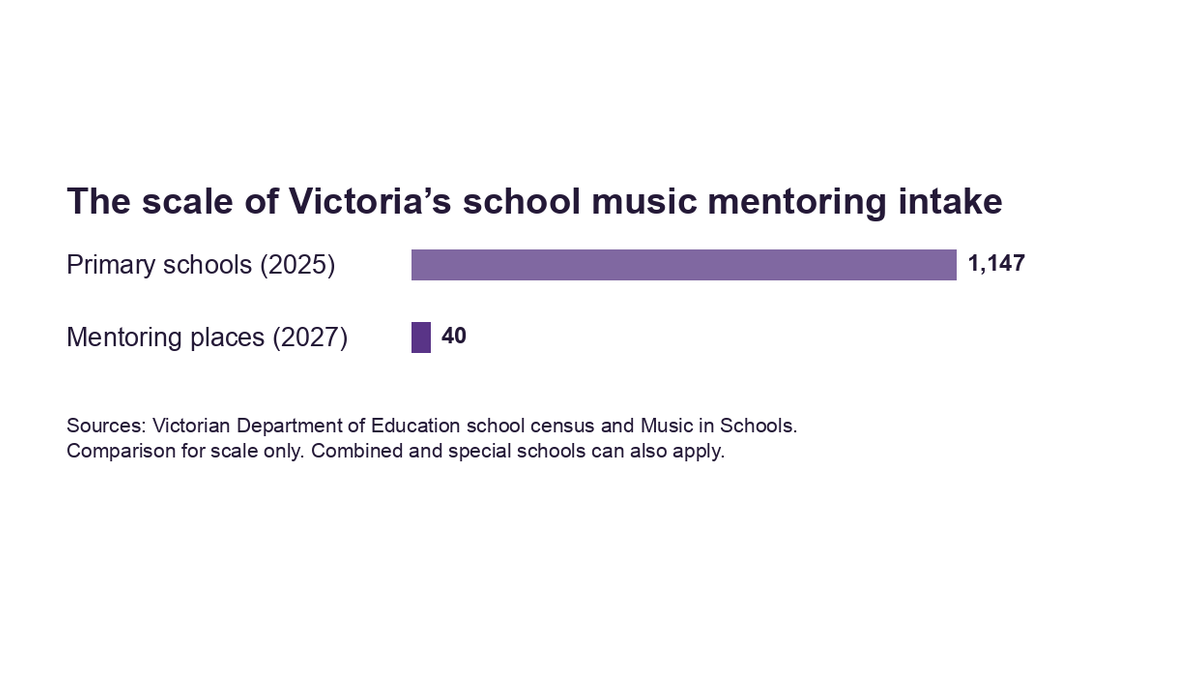
The Victorian Department of Education has 40 places for schools in its 2027 Music in Schools program. There were 1,147 government primary schools in February 2025, plus combined and special schools, some of which can also apply. Even if all 40 places went to standalone primary schools, that would reach about 3.5 per cent of that 2025 school count in one year. That's a comparison of the size of the intake with the size of the system. It tells us nothing about how many schools already teach music or how many applied.
There's a second number worth putting alongside it. Music Australia's 2026 review of music education cites a study that found an average of about six hours of music tuition in Victorian primary teacher training courses. That's training received by prospective teachers in the study, not the time pupils spend in class. Six hours helps explain why a year of mentoring could make a difference to a teacher asked to take a class on their own. Forty places limits how far that help can go.
I'd fund more mentoring and give schools ongoing money for teaching time, ensemble rehearsals and instrument servicing. I'd also ask the department to report how often children get a music lesson, who teaches it and where schools can't fill teaching hours. Count the students who can take an instrument home and those waiting to borrow one. Those figures would tell us where to put the next round of money. The number of schools admitted to a mentoring program can't do that on its own.
Help with the first instrument and the first repair
I'd like Victoria to trial a universal instrument rebate that comes off the bill when you hire, buy or repair an instrument. It should be open to any Victorian taking up or continuing to play, regardless of household income. Cover hire, suitable second-hand instruments and professional repairs as well as new purchases. A fixed amount per person over a set period would give the state a way to budget for the scheme. People should be able to use it without paying the full cost up front.
Picture a student who has been offered a place in a school ensemble and needs a clarinet for the term. The school might have one to lend. If it needs work, the most useful spend may be getting that instrument serviced in time for the student to start. If there is nothing available in the loan pool, a term of hire gives the student time to find out whether they enjoy playing before the family commits to buying. A scheme that only pays towards a new instrument misses both opportunities.
A teacher or community ensemble could help someone find the right instrument, and someone learning on their own should be able to use the rebate directly. Keep the paperwork to what is needed to confirm residency and the purchase, hire or repair. Give schools a separate maintenance budget for the loan stock they already own so they can book routine servicing without waiting for individual families to apply.
Publish how many people use the rebate for hire, purchase and repair, and what each costs. A universal scheme can still show where people are struggling to get work done. If families in several towns can get an instrument but cannot find a technician within a reasonable trip, the next dollar might be better spent arranging a regional service day than increasing the rebate.
Pay for the work that puts on a gig
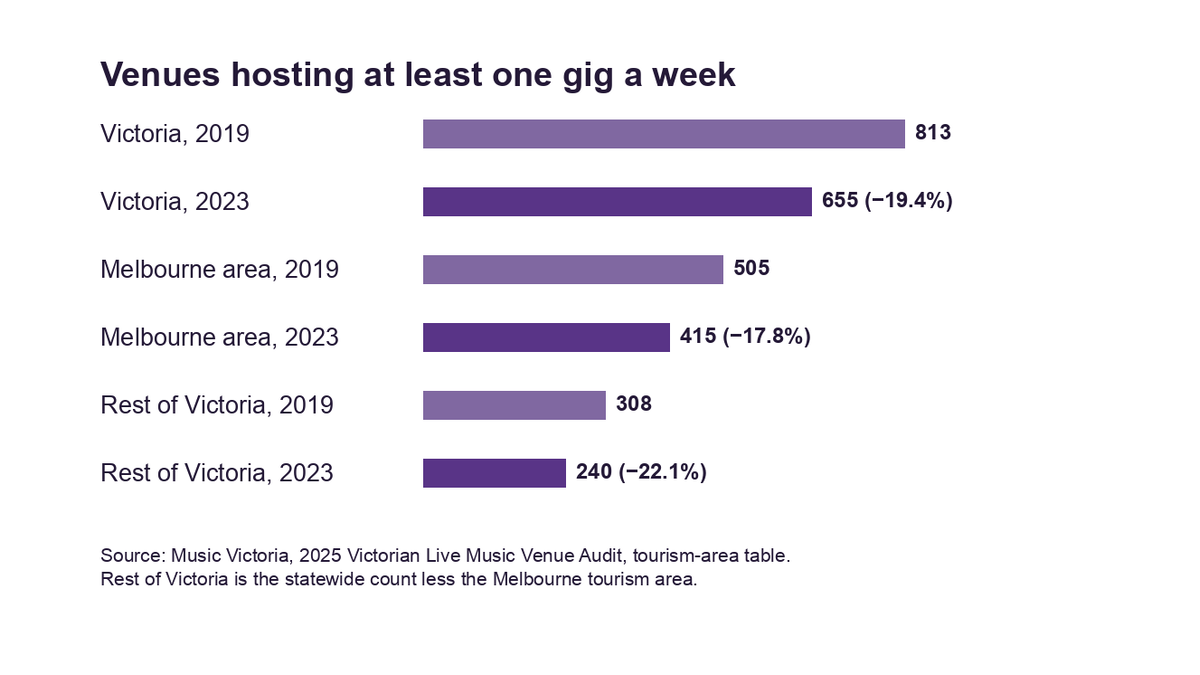
Music Victoria's 2025 venue audit, counted 813 Victorian venues putting on at least one gig a week in 2019. Its comparison table records 655 for 2023. That's 158 fewer out of the original 813, a fall of 19.4 per cent. Melbourne went from 505 to 415, a drop of 90 out of 505, or 17.8 per cent. Subtract Melbourne and the rest of the state went from 308 to 240, down 68 out of 308, or 22.1 per cent. A room can drop out of those counts while staying open and running gigs less often. What fell was the number of places putting on music every week.
In the latest rounds of Music Works and the Victorian Gig Fund, Creative Victoria announced more than $2.9 million between the two programs, supporting 130 projects and gigs at 134 venues. The two programs do different jobs. A venue grant gets a paid gig on the calendar. A Music Works grant can pay for a recording, a tour or other work an artist needs to do before a show can happen. Those recipient counts tell us who gets funded in that round. To judge whether the money meets demand, I'd want to see eligible applications and the dollars requested alongside the awards, by region and by type of work.
I'd keep both kinds of grants and fund them over several years. A small tour can make musical sense and still fail on the spreadsheet. The second show helps cover the drive. The third might mean another night away and another shift missed. Paying a sound engineer or rehearsing the new set costs money before a ticket goes on sale. The test of a funding program is whether an artist can take on that work and pay the people who do it. For venues, I'd keep tracking the number able to put on gigs week after week.
Fund music technology that people can actually use
Victoria's 2026–27 budget allocated $4.5 million to a package of contemporary music initiatives, including Music Works, Songwriting in Schools and the Victorian Music Development Office. I haven't found a separate figure in that announcement for practical music technology trials. I build music software and have a stake in how those trials would be designed. I'd like to see small, open funding rounds where teachers, artists and technicians can bring a problem they already have, and where developers can work with them to solve it. That might be a tool for preparing accessible parts, a better way to document a recording's credits, or a system for keeping track of the instruments a school lends out.
Give the people doing the testing paid time. A teacher who spends three afternoons working out why something fails on the school's devices has done real work. So has the musician who discovers that the export a developer thought was finished is almost impossible to read on a stand. A useful trial needs a budget for those afternoons and enough time for the developer to fix what they find.
Fund maintenance where a tool proves itself. Ask how a user can get their scores, recordings or records out when they move on. A school should be able to keep the work students made after a pilot ends. A band should be able to hand a chart to a substitute who uses a different app. Those are practical terms for public investment, whichever company ends up building the software.
Keep the work at the bench viable
Victoria's accreditation document for instrument making and repair reproduces figures from the Australian Music Association’s 2024 survey. Repair skills ranked first among retailers and second among wholesalers. Sixty-one per cent of responding retailers reported the shortage, as did 47 per cent of responding wholesalers. Those percentages are for the two groups surveyed nationally. They don't tell us how many technicians Melbourne needs, how long a repair takes to book or how many instruments are sent interstate. The same accreditation document says the Victorian Certificate IV averaged 14 enrolments a year since 2021 at the time of reporting. Enrolments tell us the scale of the training intake, without telling us how many graduates went into each trade.
There is already a base to build on. Maton makes guitars in Box Hill, and Melbourne has specialist violin making and restoration. Public funding could help smaller workshops pass on skills, take on regular servicing and invest in equipment they can keep busy. I would start by asking schools, repairers and instrument shops what they send away, where it goes and how long they wait. That's the evidence we'd need to decide which capabilities to build here first.
I want it to be ordinary for a Melbourne player to be able to bring an instrument to someone nearby who can assess it, explain what needs doing and help keep it in service. I want regional players to have a dependable route to that expertise too. Some specialist work will always travel. It would be good to have more of the everyday work, and more of the difficult work, within reach in Victoria.
There are two parts to getting there. Give established workshops paid time to teach, because time spent supervising a trainee is time away from the paying jobs already on the bench. Then give those workshops enough regular work to justify taking someone on. Schools and community ensembles could pool servicing orders, for example, so a repairer can plan a run of jobs and a trainee can see the same kind of fault across several instruments. Small makers could apply for shared tooling or short production runs when there is a plausible buyer, such as a school programme testing a durable design.
I'd ask technicians, teachers and ensembles where work is hardest to get done before deciding what to fund. A string setup, a seized valve and an amplifier fault call for different skills. A list of workshops by instrument and region, with honest lead times and referral options, would also help families find the people who are already here.
What would change by next year?
When governments talk about supporting Victorian music, I'd like to be able to ask what a student, a working musician or a repairer could reasonably expect to be different by the following year. Can the student borrow something playable? Can the musician afford to take a small show on the road? Can the workshop afford to teach somebody while staying open? Each answer should have a budget and someone responsible for delivering it.
Music Victoria has given people a reason to talk about the future of music in this state. I'm glad it has. The part I want to keep talking about is how someone gets from being interested in music to actually making it, and what it takes for them to keep going. That can come down to a teacher with time, a room that will book them or a person down the road who knows how to get the instrument playing again. Those are things Victoria can choose to fund.
Put the idea into practice
Crescender helps musicians, teachers, and families organise the work around music without scattering it across disconnected tools.
Start now